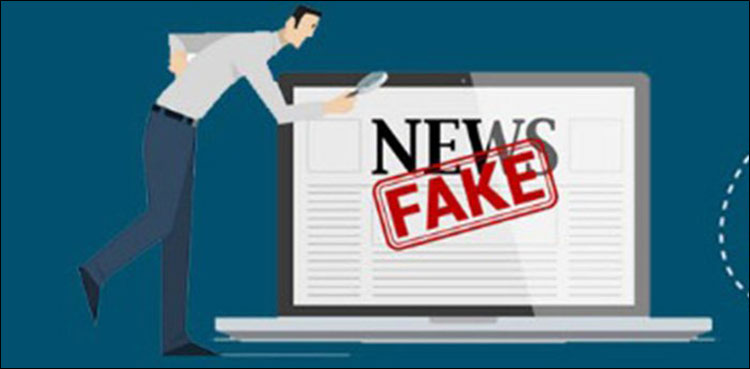
China bans ‘fake news’ created with AI, bots

Fawad Chaudhry

China has issued new rules banning online video and audio providers from using artificial intelligence (AI) and virtual reality technologies to produce “fake news.”

The regulation published Friday by China’s cyberspace authority said that both providers and users of online video news and audio services are “not allowed” to use new technologies such as deep learning and virtual reality to create, distribute and broadcast “fake news.”

“Fake news” has been generalised to mean anything from a mistake to a parody or a deliberate misinterpretation of facts.

The rules come into effect on January 1, 2020.

Failure to follow them could be considered a criminal offence, the Cyberspace Administration of China (CAC) said, without offering details on punishments.

The rules require videos and audio tracks produced using AI or virtual reality technologies to carry clear labels warning users.

The regulations particularly stressed the dangers of “deepfakes,” or technology that manipulates videos to appear genuine but which depict events or speech that never happened.

Deepfake technologies could “disrupt social order and violate people’s interests, creating political risks and bringing a negative impact to national security and social stability,” the cyberspace authority warned.

Concerns over deepfakes have grown since the 2016 US election campaign which saw wide use of online disinformation, according to US investigations.

China’s top legislative body said earlier this year it was considering making deepfake technology illegal.

A Chinese face-swapping app Zao, which allows users to convincingly superimpose their own likeness over characters in movies or TV shows, led to a heated debate on the abuses of deepfake technologies in September.

The post China bans ‘fake news’ created with AI, bots appeared first on ARY NEWS.

Comments

Popular posts from this blog

Accountability court hears assets case against Ishaq Dar

ISLAMABAD: An accountability court in Islamabad on Wednesday resumed the hearing of a reference filed against former finance minister Ishaq Dar by the National Accountability Bureau (NAB) for allegedly accumulating assets beyond his known sources of income.  Judge Muhammad Bashir is recording the statement of a prosecution witness, Ishtiaq Ahmed. At the previous hearing, the accountability judge had reserved his verdict on an application filed by two co-accused seeking acquittal in the case. Naeem Mehmood and Mansoor Rizvi, who are directors of Dar’s companies, had filed the application requesting the judge to exonerate them from all charges for want of evidence. Qazi Misbah, the counsel for the two co-accused, contended the prosecution has failed to provide compelling evidence to prove the allegations leveled against his clients. The third co-accused President National Bank of Pakistan (NBP), Saeed Ahmed, had already filed an application before the court for his acquittal wh...

10 creepy celebrity wax statues

Waxworks of celebrities, sports persons and politicians such as Tom Cruise, Barack Obama and Christiano Ronaldo are admired by people all over the world. The craft requires taking careful and accurate measurements to create these wax statues, which are then polished and perfected to make for an exact replica. Madame Tussaud’s is one of the most famous museums in the world that displays wax statues, however, not all wax museums in the world craft flawless statues. Compiled from Cosmopolitan India , here is a list of the creepiest celebrity wax statues. Barack Obama PHOTO: COSMOPOLITAN David and Victoria Beckham PHOTO: COSMOPOLITAN Jennifer Aniston PHOTO: COSMOPOLITAN Beyonce’s wax statue sparks outrage Jennifer Lopez PHOTO: COSMOPOLITAN Justin Bieber PHOTO: COSMOPOLITAN Justin Timberlake PHOTO: COSMOPOLITAN Aamir Khan PHOTO: COSMOPOLITAN Katrina Kaif PHOTO: COSMOPOLITAN London’s Tussauds gets to work on Trump wax figure Selena Gomez PHOTO: C...

Qatar to hike minimum wage ‘by end of year’

DOHA: Qatar could increase the minimum wage for migrant workers by the end of 2018, unions predicted on Monday, as the 2022 World Cup host seeks to push through labour reforms. It would be the first change to the monthly wage since its introduction by the gas-rich Gulf state last November. “By the end of the year we expect a new minimum wage to be set, that’s good news,” said Sharan Burrow, general secretary of the International Trade Union Confederation. Burrow did not name a figure but said the new wage would be calculated by assessing a “basket of goods”. She was speaking after meeting Qatar’s labour minister, Issa al-Jufali al-Nuaimi, and other government officials in Doha over the past two days. The minimum wage was set at 750 riyals a month ($206, 170 euro) on its introduction. In addition to the salary, labourers receive free accommodation, food and healthcare plans, covered by employers. The 750-riyal figure has been criticised as too low. “We believe it is not good e...