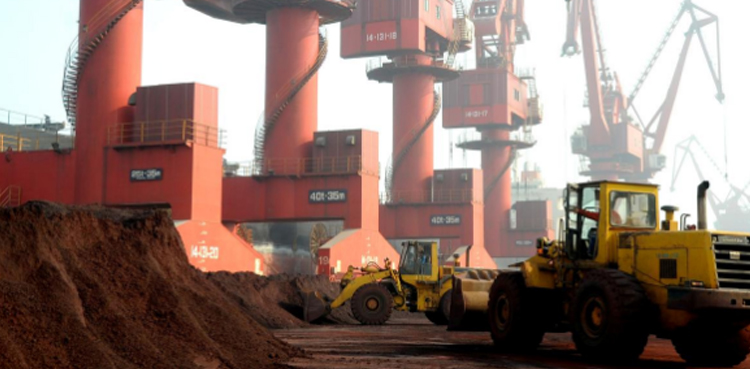
WASHINGTON: Rare earth elements are used in a wide range of consumer products, from iPhones to electric car motors, as well as military jet engines, satellites and lasers.
Rising tensions between the United States and China have sparked concerns that Beijing could use its dominant position as a supplier of rare earths for leverage in the trade war between the two global economic powers.
WHAT ARE RARE EARTHS USED IN?
Rare earths are used in rechargeable batteries for electric and hybrid cars, advanced ceramics, computers, DVD players, wind turbines, catalysts in cars and oil refineries, monitors, televisions, lighting, lasers, fiber optics, superconductors and glass polishing.
Several rare earth elements, such as neodymium and dysprosium, are critical to the motors used in electric vehicles.
RARE EARTHS IN MILITARY EQUIPMENT
Some rare earth minerals are essential in military equipment such as jet engines, missile guidance systems, antimissile defense systems, satellites, as well as in lasers.
Lanthanum, for example, is needed to manufacture night vision devices.
The U.S. Defense Department accounts for about 1% of U.S. demand, which in turn accounts for about 9% of global demand for rare earths, according to a 2016 report from the congressional U.S. Government Accountability Office.
WHICH COMPANIES ARE MOST DEPENDENT ON CHINESE SUPPLIES?
Companies such as Raytheon Co, Lockheed Martin Corp and BAE Systems Plc all make sophisticated missiles that use rare earths metals in their guidance systems, and sensors. Lockheed and BAE declined to comment. Raytheon did not respond to a request for comment.
Apple Inc uses rare earth elements in speakers, cameras and the so-called “haptic” engines that make its phones vibrate. The company says the elements are not available from traditional recyclers because they are used in such small amounts they cannot be recovered.
Since 2010, the government and private industry have built up stockpiles of rare earths and components that use them, according to Eugene Gholz, a former senior Pentagon supply chain expert, who teaches at the University of Notre Dame.
Some suppliers have scaled back their use of such elements, he said.
WHAT ARE RARE EARTHS AND WHERE DO THEY OCCUR?
Rare earth metals are a group of 17 elements – lanthanum, cerium, praseodymium, neodymium, promethium, samarium, europium, gadolinium, terbium, dysprosium, holmium, erbium, thulium, ytterbium, lutetium, scandium, yttrium – that appear in low concentrations in the ground.
Although they are more abundant than their name implies, they are difficult and costly to mine and process cleanly. China hosts most of the world’s processing capacity and supplied 80% of the rare earths imported by the United States from 2014 to 2017. In 2017, China accounted for 81% of the world’s rare earth production, data from the U.S. Geological Survey showed.
Importers made limited efforts to reduce rare earth consumption and dependence on China after a diplomatic dispute between China and Japan in 2010. Japan accused China of halting rare earth supplies for political reasons, sparking recognition worldwide of the risks of dependence on one supplier. China denied it had halted supplies.
Few alternative suppliers were able to compete with China, which is home to 37% of global rare earths reserves.
California’s Mountain Pass mine is the only operating U.S. rare earths facility. But MP Materials, owner of Mountain Pass, ships the roughly 50,000 tonnes of rare earth concentrate it extracts each year from California to China for processing. China has imposed a tariff of 25% on those imports during the trade war.
Australia’s Lynas Corporation Ltd this week said it signed a memorandum of understanding with Texas-based Blue Line Corp to build a rare earth processing facility in the United States.
Rare earths are also mined in India, South Africa, Canada, Australia, Estonia, Malaysia and Brazil.
HOW ARE RARE EARTHS AFFECTED BY U.S. TARIFFS?
So far, the U.S. government has exempted rare earths from tariffs on Chinese goods.
OPTIONS TO REDUCE RELIANCE ON CHINESE IMPORTS
U.S. senators introduced legislation in May to encourage development of domestic supplies.
Recycling has also emerged as a potential source for rare earth minerals.
Nebraska-based Rare Earth Salts is taking old fluorescent light tubes and recycling them for their rare earth elements, which comprise about 20 percent of the bulb, according to the Association of Lamp and Mercury Recyclers.
HOW HAVE RARE EARTHS PRICES REACTED TO THE RISING TENSIONS?
Having held largely steady for the past several months, the export prices of an array of rare earth elements have rallied strongly since Chinese President Xi Jinping’s visit to a rare earth processing firm in southern China on May 20 brought the sector under the spotlight.
The price of neodymium metal – used in magnets and speakers – increased 26.5% since May 20 from $50 per kilogram to $63.25/kg. Dysprosium metal (used in lasers), erbium oxide and gadolinium oxide (used in medical imaging and fuel cells) are up around 10%.
The post China’s rare earth supplies could be vital bargaining chip in US trade war appeared first on ARYNEWS.
Comments
Post a Comment